Why Licorice Root (Gan Cao) Appears in Almost Every Chinese Herbal Formula
There is an old saying in Traditional Chinese Medicine (TCM):
“Of ten formulas, nine contain Licorice Root.”
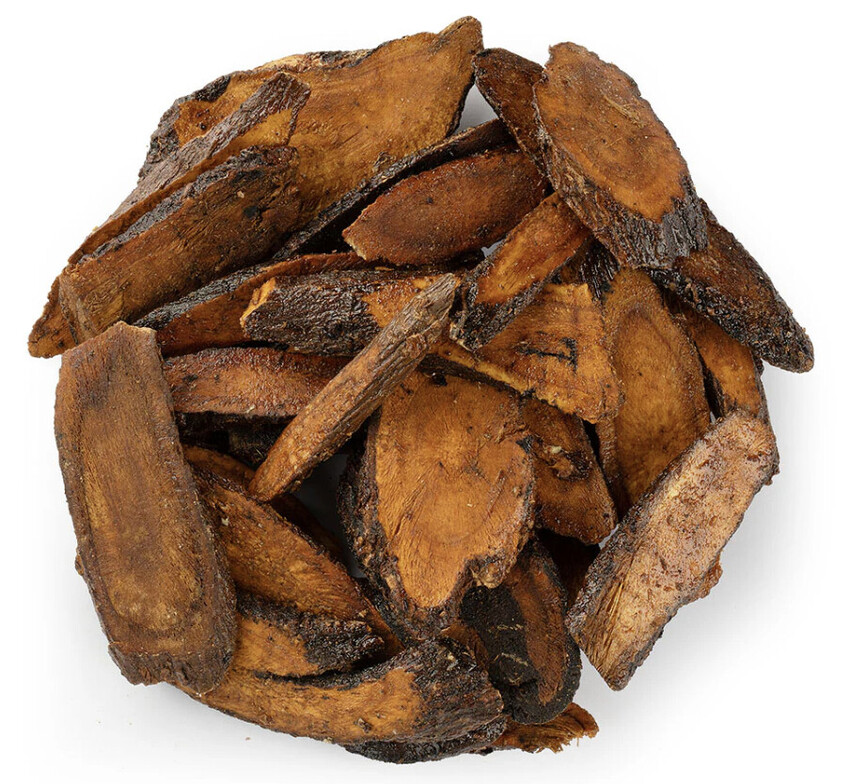
The phrase has survived for centuries because Chinese herbalists repeatedly noticed the same thing: Licorice root (Gan Cao, or it's "honey prepared" form, Zhi Gan Cao) appears in an astonishing number of classical Chinese herbal formulas.
Modern analysis of large databases of over 96,000 traditional Chinese herbal medicine formulas (remember: each formula is a combination of herbs!) has found that the old saying was not far from the truth. Gan Cao is the most frequently used herb in the entire history of Chinese medicine. It appears throughout the great classical formula traditions of the Shang Han Lun, Jin Gui Yao Lue, Ming Dynasty herbal medicine texts, and modern Traditional Chinese Medicine prescriptions still used by practitioners around the world today.
This naturally raises an important question: why did Chinese physicians rely so heavily on Gan Cao for nearly 2,000 years?
The answer reveals something profound about the philosophy of Chinese herbal medicine itself.
Licorice Root in the Earliest Chinese Materia Medica Texts
Licorice root first appears in the Shen Nong Ben Cao Jing (“Divine Farmer’s Classic of Materia Medica”), one of the oldest surviving Chinese herbal medicine texts, compiled during the Han Dynasty roughly between the first and second centuries CE. In this foundational Chinese materia medica, Gan Cao was classified as an “upper-grade herb”, a category reserved for herbs considered safe, nourishing, and appropriate for long-term use.
Importantly, ancient Chinese physicians did not merely classify herbs according to whether they attacked disease. Herbs were also evaluated according to whether they preserved vitality, protected digestion, and supported the body’s ability to tolerate treatment itself. Licorice root quickly developed a reputation as one of the great stabilizing herbs of Chinese medicine.
Several centuries later, the physician-scholar Tao Hongjing (456–536 CE), one of the most influential commentators in Chinese herbal medicine history, elevated Licorice’s status even further. Tao Hongjing wrote that Gan Cao was “the foremost leader among the many medicines” and observed that classical formulas “rarely go without it.” These statements likely helped inspire the later proverb: “Of ten formulas, nine contain Licorice root.”
Why Licorice Became Known as the “Great Harmonizer”
Licorice eventually became known by another fascinating name in Chinese herbology: Guo Lao, often translated as “The National Elder” or “Elder Statesman.”
This metaphor tells us a great deal about how Traditional Chinese Medicine understood the herb. Licorice was not viewed as the emperor or conquering hero of a formula. Instead, it was viewed as the wise senior minister who helped the entire formula function cohesively.
Classical Chinese herbal formulas often combined herbs with very different properties:
-
warming herbs
-
cooling herbs
-
drying herbs
-
moistening herbs
-
descending herbs
-
dispersing herbs
-
tonifying herbs
-
strongly purging herbs
Chinese physicians recognized very early that combining potent medicinal substances could easily overwhelm digestion or create imbalance within the patient. Licorice root became famous because it appeared to help formulas become more tolerable, integrated, and balanced.
This is the meaning behind the classical phrase:
“Harmonizes the various herbs.”
In Traditional Chinese Medicine theory, Licorice root was believed to soften harshness, moderate toxicity, reduce excessive heating or cooling effects, ease spasms, and protect digestion and assimilation, what is often called the Spleen and Stomach system (also referred to as Middle Jiao).
Licorice and the Chinese Medicine View of Digestion
One of the most important ideas in Chinese herbal medicine is that treatment should not damage the patient’s digestive capacity. Ancient Chinese physicians believed that even a theoretically correct herbal formula could fail if it overwhelmed the digestive system.
Licorice's sweet and relatively neutral nature made it uniquely suited to mediate this problem. In many traditional Chinese herbal formulas, Licorice functions almost like connective tissue within the prescription, helping the body tolerate stronger herbs while allowing opposing medicinal strategies to coexist within a single formula. It soothes and creates synergies.
This is one reason Licorice appears so frequently in the formulas of Zhang Zhongjing, author of the Shang Han Lun and Jin Gui Yao Lue, two of the most influential books in the history of Traditional Chinese Medicine. Licorice repeatedly appears in formulas designed to treat cold disorders, digestive disorders, spasms, cough, fatigue, and complex mixed-pattern conditions.
Even modern English-language Chinese materia medica textbooks, including those by Bensky and by John and Tina Chen, continue to teach Licorice root according to these same classical principles: harmonizing formulas, moderating harsh herbs, reducing toxicity, and protecting digestion.
“Entering All Twelve Channels” in Chinese Herbal Theory
Traditional Chinese Medicine texts also describe Licorice as “entering all twelve channels.” Modern readers sometimes interpret this phrase mystically, but classical physicians appear to have meant something more functional.
Licorice was considered broadly compatible and non-extreme in its directional action. It was not strongly ascending, descending, purging, or dispersing. Because of this balanced quality, Licorice could participate almost anywhere within a formula and help coordinate different therapeutic actions.
In practical terms, Chinese physicians viewed Gan Cao as a mediator. It helped powerful herbs coexist without excessive conflict inside the body.
What Licorice Reveals About Traditional Chinese Herbal Medicine
The history of Licorice reveals something important about classical Chinese medicine. Traditional Chinese herbal formulas were never viewed simply as collections of isolated active ingredients. They were designed more like ecosystems.
One herb attacked pathology. Another protected fluids. Another strengthened digestion. Another directed the formula upward or downward. Licorice often occupied the center of that ecology, helping the formula behave as a coordinated whole rather than a collection of competing substances.
That may be why Licorice remained one of the most consistently used herbs in Chinese medicine for nearly 2,000 years: from the Han Dynasty to modern herbal clinics around the world today.
Not because it was necessarily the strongest herb in the formula. But because it helped everything else work together.
If you're taking a Chinese Herbal Formula, go look at the ingredients and see if it's there! Look for "Gan Cao" or "Zhi Gan Cao".
Kim Drolet
Contact Me